

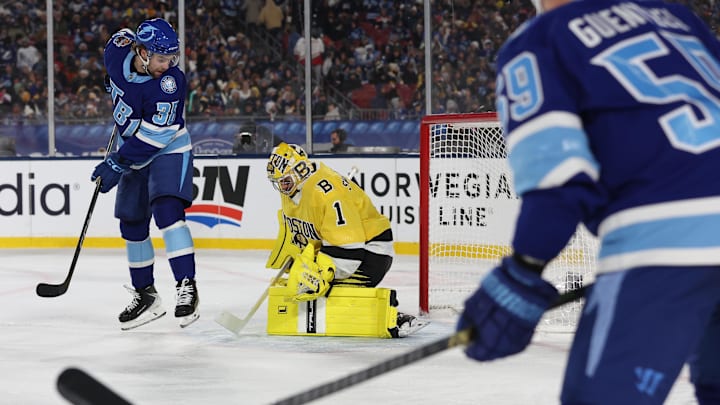
The problem with being an aggressive team is that you'll take a lot of penalties in a league where every team is becoming more and more talented on the powerplay. The problem with taking a lot of penalties is that you'd better hope your penalty kill is one of the best in the league. The Boston Bruins are the most-penalized team, and unfortunately, they sit fifth-worst in the NHL in penalty killing with a 76.4% success rate.
The ugly penalty kill reared its ugly head again before the Bruins' Olympic break with the debacle against the Tampa Bay Lightning in the Stadium Series game. The Lightning scored three consecutive powerplay goals in the second period to help erase a four-goal deficit, before tying the game in the third and winning it in a shootout. It proved that this team can't stay disciplined, so the only logical next step is to make the penalty kill elite.
Marco Sturm said that a focus for him and his coaching staff during the break was working on the penalty kill.
— Conor Ryan (@ConorRyan_93) February 18, 2026
It's an unfortunate situation for Sturm and the coaching staff to be in. The easy fix is to stay more disciplined, but they have to live with the roster decisions they made in concert with the front office in the offseason. If you wanted a team that stayed out of the box, you wouldn't have made it a priority to load up a roster that can push other teams around.
How the coaching staff can fix the Bruins' penalty kill
The Bruins' penalty kill has been visibly struggling for the past couple of weeks. The staff is implementing a system that has more movement, where the weak-side defenseman moves up into the triangle created by a 1-3-1 powerplay to attempt to take away the dangerous bumper position and crack down on cross-seam passes.
The problem with that method is that teams are gameplanning how to contend with it. The obvious hole in the team's penalty kill is when the weak-side defenseman pops up to cover the bumper, it is leaving just one defenseman back to cover the net front. Opposing teams are now making sure that two forwards shift down low when it happens, which causes a small area 2-on-1.
The Bruins' most common goal against on the penalty kill has been in that situation. The player who receives the puck below the goalline can stuff it short-side or hit a teammate on a cross-crease pass if the lone defender overcommits.
One fix for the penalty kill is for the defensemen to stay more at home in front of the net instead of chasing the puck around the perimeter. Charlie McAvoy has been a culprit of trying to do too much when he chases the puck out towards the blueline, and has left his partner all alone in front.
Boston's best plan if wanting to clog the middle of the ice on the penalty kill is to adopt the wedge +1 system. This creates a tight triangle in the slot area, with two defensemen and one forward, while the fourth forward covers passes around the top and flanks.
Czech Press Penalty Kill formation (also called Wedge +1)
— Jen LC (@RegressedPDO) March 12, 2016
PK (red) vs. an Overload Power Play (blue) pic.twitter.com/J3vUd3ajYH
The new system would eliminate the 2-on-1 situations down low, and instead rely on the goaltenders to handle the shots from the outside. There might be some extra chances for teams to move pucks quick from the top to the flanks, but it would at least create a different look than what the Bruins are giving teams currently.
 Add us as a preferred source on Google