

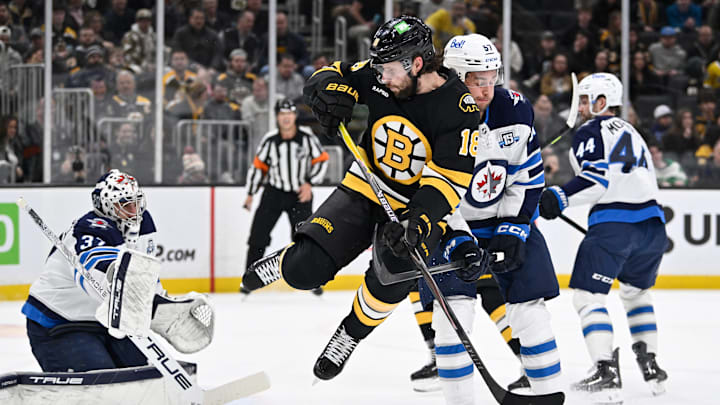
Marco Sturm must feel like Reggie Dunlop in the film Slapshot. Constantly being asked about the struggling power play, except Sturm cannot respond with the iconic phrase, “yeah, we’re working on it”. At least the Charlestown Chiefs had a bad power play the whole year, as opposed to this Boston Bruins team, which has hit a wall since coming out of the Olympic break.
The Bruins' first game after the Olympic break was on February 26th. Since then, the power play is 28th in the league, clipping at just over 12%. Before the break, they were third in the league, converting over 26%. Multiple players on the first unit are having career years (McAvoy, Geekie, and Pastrnak), and somehow, when they all get out there together lately, things look disjointed.
The most glaring issue is the zone entries. The Bruins, like most of the NHL, use a system where a skater will take the puck to about the red line and drop it to a trailing skater. The idea is that the penalty killers will be flat-footed standing at the blue line, and the attacking team will be able to easily skate the puck into the zone and set up the power play.
It is too predictable for Boston right now; teams seem to know exactly what they are doing in the neutral zone, and just getting the puck into the attacking zone is painful, at times.
Call it an embarrassment of riches?
As poor as the first unit has been, the second unit seemed to breathe some life into the man advantage for Boston. It is hard not to point at the newest member of the team, Lukas Reichel. Acquired in a trade from Vancouver at the closing moments of the NHL Trade deadline, and after playing a handful of games in Providence, Reichel was recalled before Thursday night’s matchup with the Winnipeg Jets. From his first shift, you could tell that there was a reason Don Sweeney and co. wanted to take a chance on this player.
The first thing you notice is the speed; it adds a completely different element to this lineup. It could be a glimpse of what Bruins' top prospect, James Hagens, could bring if/when the team decides to give him a chance after his season with the Boston College Eagles is over. Reichel was a catalyst for the second power play unit in the first period. He dominated retrieving loose pucks and capped off a great shift by setting up Casey Mittlestadt, which led to a shot off the post. Reichel would go on to add his first as a Bruin, with an unassisted tally in the second period.
It should be no surprise that the second unit thrives when they do get their opportunity. Being made up of players with experience on the man advantage, like Mason Lohrei, the aforementioned Mittelstadt, and Viktor Arvidsson, is certainly a plus. Their main attribute is mostly the fact that they can sense the fact that the first unit is really struggling, and sometimes the “chip it in and chase it down” method is exactly what is needed.
The thing about bad power plays is that not only does it give the opposing team unnecessary life, but it can also be deflating to the team continuing to fail. It will be interesting to see if Marco Sturm will shuffle the units, trying to get something to work, or doesn’t want to change what has been working; these are the guys that were top in the league a few short months ago.
 Add us as a preferred source on Google